For visiting the official Forms in Nature website please click here.
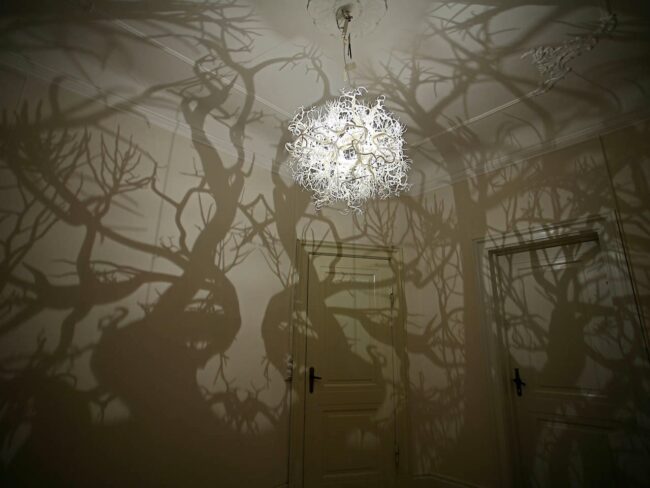
The Light sculpture Forms in Nature resembles Darwinist Ernst Haeckel’s drawings . Using a simple action, such as intensifying the brightness at the center of the artwork, the light transforms the space and adds character, as the work throws oversized shadows onto walls and ceilings in the space in which it hangs.
The light sculpture Forms in Nature is partly inspired by Ernst Haeckel’s (1834- 1919) detailed plots from nature and is a further development of Hilden & Diaz’ fascination with mirrorings, as they have previously applied in other artworks.
Forms in Nature is a artwork with a light source surrounded by a dense and unruly tree and root system created in minature sculpture. The forest is mirrored around it’s horizontal central axis and forms a circle 360 degrees around the light source and thereby leads one onto the notion of a real world versus an underworld.

Interestingly, the roots are those elements of the forest that are the most visible. Thereby the sculpture is not only mirrored, but also turned upside down in Hilden & Diaz’ artwork. As the intensity of the light source increases, the room changes and the space slowly becomes more and more fascinating and unheimlich.
The shadows engulfs the room and transforms the walls into unruly shadows of branches, bushes and gnarled trees. Mirrorings are thrown out upon the walls and ceilings and provide weak Rorschach-like hints of faces, life and flow of consciousness. Diming the lights transforms the installation and one senses a weak fire burning deep in the center of the forest.
For order information please contact: info@formsinnature.dk
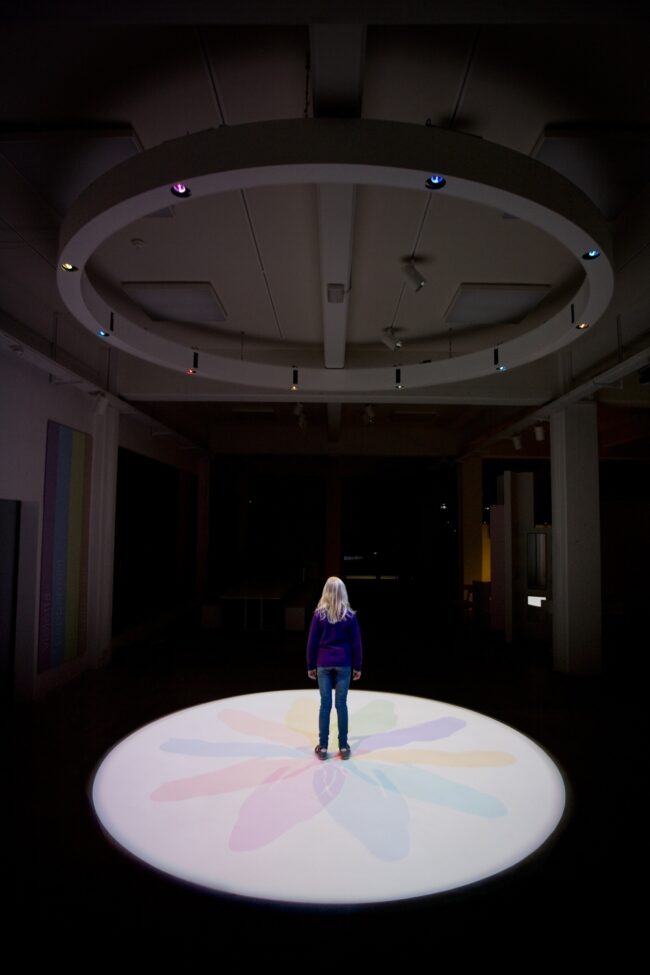
Viewed from outside, the work is a great circle located in the ceiling from which white light is spreading in to the room. The moment the viewer enters the circle, the white light will be broken as in a prism, and 52 contrast-colored shadows will be thrown into a star shape around the viewer. This makes all the colors, which previously have been present in the white light, visible to the viewer as a color palette on the floor.
text By Gianni Mercurio
As long as the Coliseum exists, Rome will exist; when the Coliseum falls, Rome will also fall; but when Rome falls the world will fall too. – The Venerable Bede, early 8th century
In the first decades of the twentieth century the historic avant-garde movements realized that it was possible to replace representations of objects with a straightforward presentation of them. But whoever would have believed that, in time, nature itself would then be added to them? It was in the 1960s above all that a series of genial ideas led to the use of the four natural elements: air, earth, fire, and water.
The use artists have made of fire in the development of this new aesthetic is surprising. In classical iconography fire conveyed a moral message: on the one hand, fire was an incomparably destructive element, the herald of disasters and a symbol of divine punishment; on the other hand it symbolically embodied the image of life, the essence of divinity. It was a manifestation of God who, through fire, was made perceptible to the human senses.
The French artist Yves Klein was among the first to realize fire’s potential for new art. Together with the architect Werner Ruhnau, in 1961 he created an installation, Mur de Feu. This was in Krefeld, a German town near Düsseldorf, in the garden of Mies van der Rohe’s Lange House. The installation consisted of five flames arranged in a regular grid. Another work made in the same place was Sculpture de Feu, a column of fire over three metres high. “Space is what is immaterial and limitless” said Klein, and he established walls and floors with an architecture of air and fire. The installation had a double aim: to change the concept of architectural space, by pushing to the limit’s Mies’s axiom that “less is more”, and to give the viewer to a sense of immateriality and purity which, for Klein, was art’s ultimate aim.
[youtube https://www.youtube.com/watch?v=_FzuH8-kdwM&w=560&h=315]
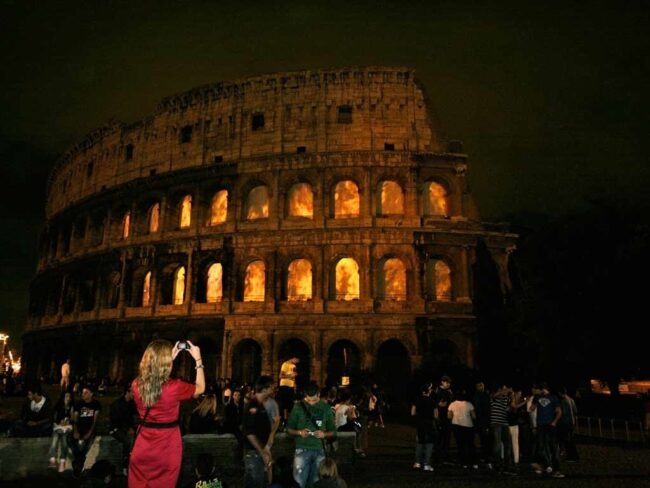
I have presented this very brief overview in order to establish Klein as a touchstone for Coliseum on Fire. This multimedia installation by Thyra Hilden and Pio Diaz will create an amazingly realistic impression of the Coliseum in flames. The artists’ aim is to show just how fragile and fleeting are mankind’s creations, even great buildings that are still considered symbols of eternal culture. In this sense Coliseum on Fire is a humanist project because the image of this great monument in flames cancels the manifest meaning of the Coliseum: a theatre for cruel, deathly combat for the public’s enjoyment.
Thyra Hilden’s and Pio Diaz’s Coliseum has been transformed into a visionary landscape. But once this incendiary installation has been dismantled it will no longer exist due to the vary fact that it was part of a specific architectural context: just as Klein’s installation no longer existed when a flame died down. The difference between Klein, and Hilden and Diaz, lies in the change brought about by the data transmission revolution. This is not so much because of the technological means the two artists use, but because their return to the sphere of representation and narrative demonstrates the need of post-ideological artists to feed on visionary scenes.
The Coliseum is part of the universal collective imagery: it symbolizes a civilization that has had the deepest influence. And the very fact that Coliseum on Fire is constructed from film underlines that its image is a common fantasy. But in this work, more than a building, the Coliseum is a symbol that burns because we are dealing with a representation, a fiction, and not a genuine catastrophe: once the projectors and screens have been dismantled everything goes back to what it was previously.
http://www.flickr.com/photos/91564542@N04/8353704036/
By alluding to the myth of the phoenix, Coliseum on Fire represents the utopia of a return to the past as the path to some future human spiritual and technological evolution. Due to the fire, the empty arches of the Coliseum record the contradictory feelings of humanity in today’s society, feelings about our spiritual ruin and our possibilities of salvation. However, as Klein said, there is a hope: “Fires burn in the heart of the void and in the heart of mankind”.
text by Olga Miłogrodzka

According to Jan Assmann – a German Egyptologist – people live only through the last 80 years of history, which look back over the living generations. Next, the experience gives way to cultural memory, passed from generation to generation.Amongst the residents of Gdańsk a mere 10% experienced the end of World War II, and even less its outbreak. This year’s commemoration of the 70th Anniversary of the Outbreak of World War II aims at retaining a clear picture of 1939 events in the memory of the remaining 90% of the population. It’s a good opportunity to give those events some thought and see what image of war will emerge before our eyes, and what image we want to commemorate.
Cultural memory, in Assmann’s view, has two faces. It can take a potential course, when the knowledge of historic events is subject to passive storing and mindless repetition, or it can take the present course, when the sources of knowledge serve the contemporaries as the points of departure for the brand new interpretations reflecting the context of time and place in which they are made. The relation, described by Assmann, between the semantics of historic time and the present, has been underscored by a wide circle of humanists in the last few decades. Prof. Mieke Bal, for instance, when doing research on Baroque Art and later interpreting the findings, used the term “preposterous history”, indicating chronological precedence of the contemporary events over the past 17th century ones. According to Bal, the present time dictates to us, or even imposes, the way of thinking about the past, somehow shaping it again in its own way. I dare say: September 2009 and September 1939 are both equal heroes of the commemoration. I guess Thyra Hilden and Pio Diaz, whose artistic project will be shown in Gdańsk 1st Sep 2009, would fully agree with the statement. Their project does not attempt to reconstruct historic events, but to see them from the angle of a contemporary world reality, which is better known and better understood. To tell the truth, it seems to be the only thing we can do, we the young generations, if we want to make the images of war from 70 years ago less alien and distant; we should find a point of reference for them, and at least to some extent experience them in our own way.
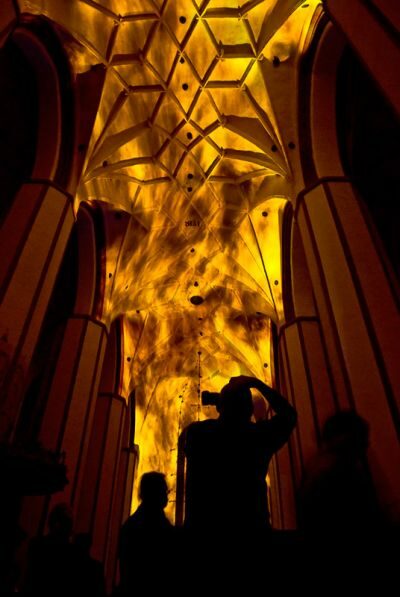
“City on fire” is artistically (but not technically) a very simple work of art. It consists of unreal, but incredibly realistic, clouds of raging and roaring fire. Despite that, when standing in the Holy Trinity Church which is “burning”, it will do to ask a simple question: what can I see? Is it the fire – the distinguishing feature of World War II, the well-known picture from war films, documentaries, photos; the fire from that time, on the one hand terrifying, yet, completely harmless as it’s so distant and fictional? If so, then there could be nothing more misleading and illusive. Because what is the difference between the destructive element of fire which ravaged Gdańsk and Hiroshima in 1945, and the one which razed World Trade Center to the ground a few years ago, or ostentatiously destroyed the Danish flags, or in the recent years claimed thousands of lives in Lebanon, Tajikistan, Afghanistan, Iraq, Gaza, Chad, Sudan, Somalia, Sri Lanka, Georgia and many other countries worldwide? I’d say: no difference at all. I even wonder if treating World War II in terms of “the past” should not simply fill us with disgrace.
Therefore, I would compare the picture created by Thyra Hilden and Pio Diaz in Gdańsk Church to the “dialectic picture” by Walter Benjamin; the picture in which the tragedy of both the past and the present meet for a brief moment, so brief and unexpected as the flash of flashbulbs; they recognise and shed light on each other, and bring about a state of emergency. “The past can be seized only as an image which flashes up at the instant when it can be recognized and is never seen again”, Benjamin noted, and added: “Every image of the past that is not recognized by the present as one of its own concerns threatens to disappear irretrievably”. Benjamin attributed the power of redemption to the very state of emergency. At these brief moments, he underscored, the present takes on a Messianic dimension, namely, by the power of bringing the past back to life, and rescuing it from oblivion. Who knows, perhaps it is so. Perhaps experiencing history again, experiencing it through authentic contemporary events is still possible for us. “Every second of time is the strait gate through which Messiah might enter”, Benjamin said. Let’s bear these words in mind too when commemorating World War II.
[translation: Michał Jankowski]
Assmann, Jan. Das kulturelle Gedächtnis. Schrift, Erinnerung und politische Identität in frühen Hochkulturen (Munich: Beck,1992); see also: Assmann, Jan. Collective Memory and Cultural Identity, in: New German Critique 65 (1995). Ibid. Mieke, Bal. Quouting Carravaggio. Contemporary Art, Preposterous History, Chicago: University of Chicago (1999). Benjamin, Walter, Thesis on the Philosophy of History, in: Zdanie 1 (1989).
– architectural unit on a symbolic fire.
THilden & Diaz – “Fire at Haus Hardenberg”
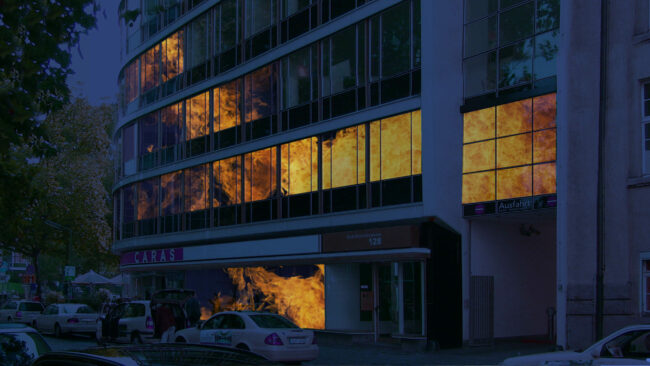
‘Burning the roots of western culture’ – This is the subtitle of an ongoing art project by the Danish-Argentinean artist duo Hilden & Diaz, creating huge symbolic fires in cities around Europe. Each night in 3 weeks of December, a fire will enlighten Haus Hardenberg in the central West Berlin.
“This time, we strike more randomly and the expression comes more irrational and open than previous”, says Diaz. Previously the artist duo has been burning central cultural institutions as city monuments, churches and museums around Europe. “This we did to question our roots, since these institutions are all of important symbolical, ideological and institutional meaning for our western culture”, says Hilden.
Fire is a symbol that contains contrasting forces; it symbolizes vitalization, but at the same time, it is a symbol of destruction. By burning a random house, the artists want to create an illusion, that there is a possibility that everything can burn down. In that way, the project has a resembling to an act of riots or of terror. “The difference is, that we wish to create an discussion and awareness of these forces. We are working with symbols, not with any destructive force. Our intention is communication”…“People in riots burn totally random things like cars or houses in their way. This kind of random fire is creating much more fear, than hitting a specific target. The latent fear is the force of terror, not the actual target”, say the artists.
In the burning of Haus Hardenberg lies a more general concern about society, than a political statement. The concern revolves around the fires in the world today and the fear they create in society. Through the Fire at Haus Hardenberg, the two artists wish to appeal to a general discussion about and an awareness of cultural questions in our society. This discussion should be available for all people and not only take place inside an art institutional frame.
Throughout history and today Berlin, is a dynamic city in change. Since the project will be returning every year in Haus Hardenberg, the artists hope, that the fire will change its meaning in connection with the ongoing changes in the city and the world. Culture will change and therefore Hilden & Diaz hope, that the perception on Fire at Haus Hardenberg will change, and follow these changes of society.

The Cradle
It seems obvious to enact City on Fire in Rome. All roads lead to Rome, the cradle of European culture. They say people with culture never go wrong, and it is true that the strong beauty of the past makes us proud and aware that we are at the top of a long evolution. We need to know our past to understand the present and learn from failures of the history of mankind. Yet, some times the past feels like a heavy burden to carry. Culture and knowledge of the past can limit your expressiveness in the present, and culture and cultural production bears an element of destruction. The pupil will have to exceed the mentor and personalize tradition. But the artists Thyra Hilden & Pio Diaz do not want to destroy the classical monuments, they are artists, and as such they encourage reflection on contemporary destruction and loss of roots. They are not political terrorists or radicals.
Symbolic Fire
As visual artists, their gesture is neither aggressive nor destructive, they do not demolish what cannot be replaced. Their art is a symbolic inferno, their fire an illusion to seduce and make us wonder what the loss of our cultural inheritance would be like. They are not simply playing with fire, they are also playing with your mind.
Cultural destruction
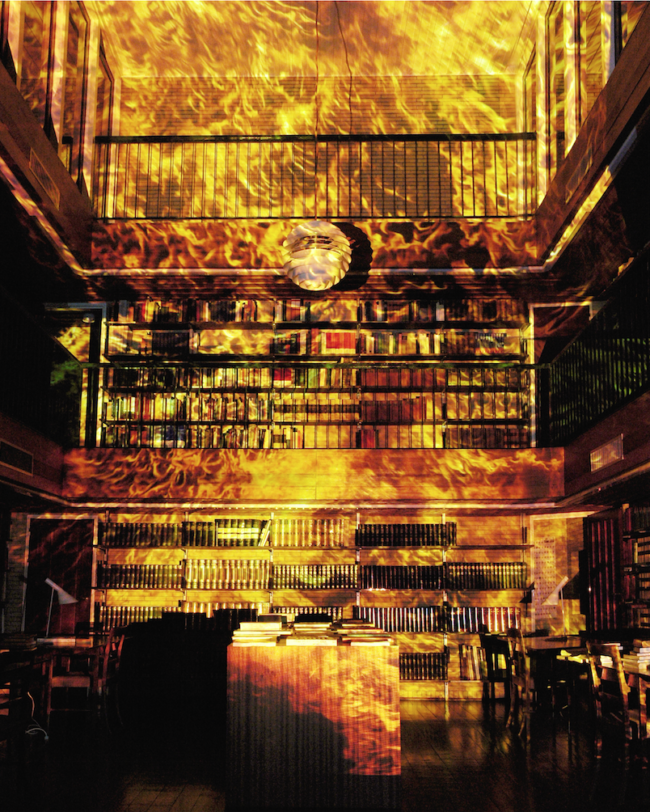
Myths of Creation do speak of destruction. You will have to tear down to build up. It seems cultures act aggressively to develop and expand. Paradigm shifts are often brutal to architectural monuments and other cultural icons. Just think of the artistic and literary treasures that were burned as Entartete Kunst by Nazis during WW2, let alone by Christians and other religious movements who feared the power of literature and culture and wanted to remove cultural products that did not fit into their ideological scheme. The images – the burning illusion – by Thyra Hilden & Pio Diaz, bring to mind all these disruptive and aggressive cultural turns.
City on Fire by Thyra Hilden & Pio Diaz celebrate the issues about the power of cultural heritage and the beauty of destruction. Their statement is a subtle intervention but proves to have a powerful impact.
Would it make life easier if you had no past, no belongings? Would we have no culture if all cultural institutions were gone? Close your eyes and watch the flames. Watch it burn to the ground. Now, how does that make you feel…?
– HildenDiaz