For visiting the official Forms in Nature website please click here.
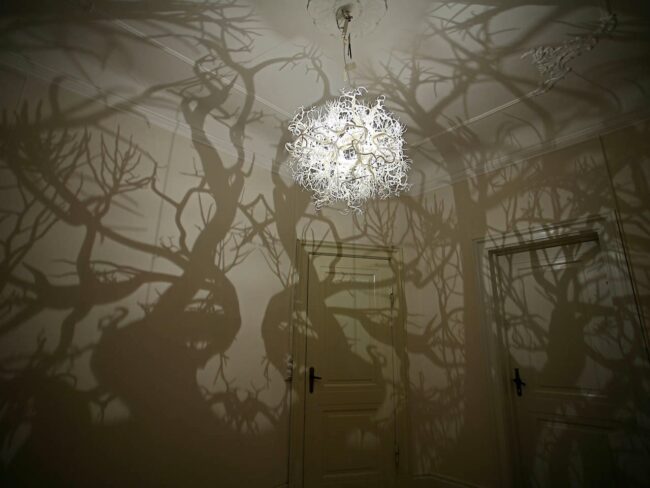
The Light sculpture Forms in Nature resembles Darwinist Ernst Haeckel’s drawings . Using a simple action, such as intensifying the brightness at the center of the artwork, the light transforms the space and adds character, as the work throws oversized shadows onto walls and ceilings in the space in which it hangs.
The light sculpture Forms in Nature is partly inspired by Ernst Haeckel’s (1834- 1919) detailed plots from nature and is a further development of Hilden & Diaz’ fascination with mirrorings, as they have previously applied in other artworks.
Forms in Nature is a artwork with a light source surrounded by a dense and unruly tree and root system created in minature sculpture. The forest is mirrored around it’s horizontal central axis and forms a circle 360 degrees around the light source and thereby leads one onto the notion of a real world versus an underworld.

Interestingly, the roots are those elements of the forest that are the most visible. Thereby the sculpture is not only mirrored, but also turned upside down in Hilden & Diaz’ artwork. As the intensity of the light source increases, the room changes and the space slowly becomes more and more fascinating and unheimlich.
The shadows engulfs the room and transforms the walls into unruly shadows of branches, bushes and gnarled trees. Mirrorings are thrown out upon the walls and ceilings and provide weak Rorschach-like hints of faces, life and flow of consciousness. Diming the lights transforms the installation and one senses a weak fire burning deep in the center of the forest.
For order information please contact: info@formsinnature.dk
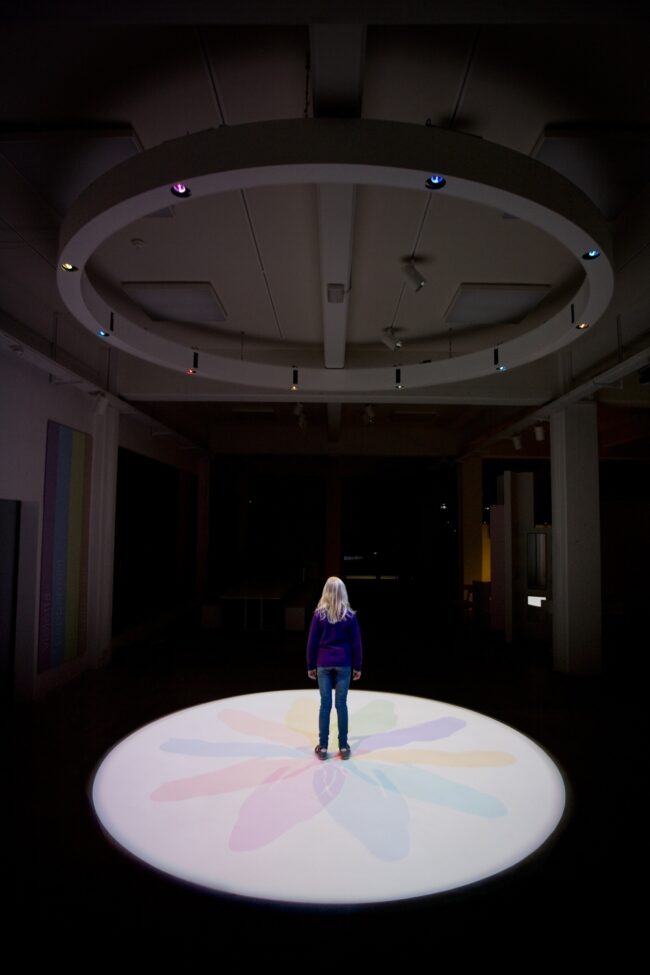
Viewed from outside, the work is a great circle located in the ceiling from which white light is spreading in to the room. The moment the viewer enters the circle, the white light will be broken as in a prism, and 52 contrast-colored shadows will be thrown into a star shape around the viewer. This makes all the colors, which previously have been present in the white light, visible to the viewer as a color palette on the floor.
text by Olga Miłogrodzka

According to Jan Assmann – a German Egyptologist – people live only through the last 80 years of history, which look back over the living generations. Next, the experience gives way to cultural memory, passed from generation to generation.Amongst the residents of Gdańsk a mere 10% experienced the end of World War II, and even less its outbreak. This year’s commemoration of the 70th Anniversary of the Outbreak of World War II aims at retaining a clear picture of 1939 events in the memory of the remaining 90% of the population. It’s a good opportunity to give those events some thought and see what image of war will emerge before our eyes, and what image we want to commemorate.
Cultural memory, in Assmann’s view, has two faces. It can take a potential course, when the knowledge of historic events is subject to passive storing and mindless repetition, or it can take the present course, when the sources of knowledge serve the contemporaries as the points of departure for the brand new interpretations reflecting the context of time and place in which they are made. The relation, described by Assmann, between the semantics of historic time and the present, has been underscored by a wide circle of humanists in the last few decades. Prof. Mieke Bal, for instance, when doing research on Baroque Art and later interpreting the findings, used the term “preposterous history”, indicating chronological precedence of the contemporary events over the past 17th century ones. According to Bal, the present time dictates to us, or even imposes, the way of thinking about the past, somehow shaping it again in its own way. I dare say: September 2009 and September 1939 are both equal heroes of the commemoration. I guess Thyra Hilden and Pio Diaz, whose artistic project will be shown in Gdańsk 1st Sep 2009, would fully agree with the statement. Their project does not attempt to reconstruct historic events, but to see them from the angle of a contemporary world reality, which is better known and better understood. To tell the truth, it seems to be the only thing we can do, we the young generations, if we want to make the images of war from 70 years ago less alien and distant; we should find a point of reference for them, and at least to some extent experience them in our own way.
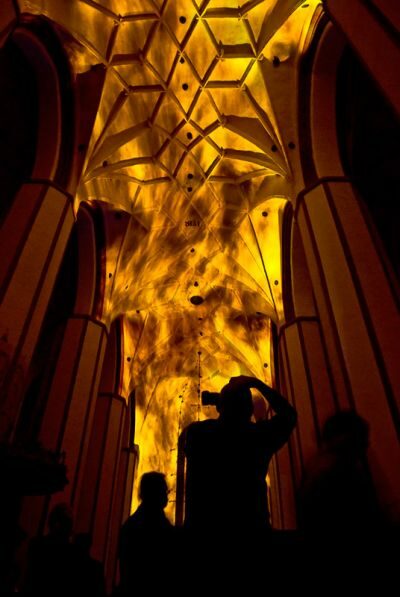
“City on fire” is artistically (but not technically) a very simple work of art. It consists of unreal, but incredibly realistic, clouds of raging and roaring fire. Despite that, when standing in the Holy Trinity Church which is “burning”, it will do to ask a simple question: what can I see? Is it the fire – the distinguishing feature of World War II, the well-known picture from war films, documentaries, photos; the fire from that time, on the one hand terrifying, yet, completely harmless as it’s so distant and fictional? If so, then there could be nothing more misleading and illusive. Because what is the difference between the destructive element of fire which ravaged Gdańsk and Hiroshima in 1945, and the one which razed World Trade Center to the ground a few years ago, or ostentatiously destroyed the Danish flags, or in the recent years claimed thousands of lives in Lebanon, Tajikistan, Afghanistan, Iraq, Gaza, Chad, Sudan, Somalia, Sri Lanka, Georgia and many other countries worldwide? I’d say: no difference at all. I even wonder if treating World War II in terms of “the past” should not simply fill us with disgrace.
Therefore, I would compare the picture created by Thyra Hilden and Pio Diaz in Gdańsk Church to the “dialectic picture” by Walter Benjamin; the picture in which the tragedy of both the past and the present meet for a brief moment, so brief and unexpected as the flash of flashbulbs; they recognise and shed light on each other, and bring about a state of emergency. “The past can be seized only as an image which flashes up at the instant when it can be recognized and is never seen again”, Benjamin noted, and added: “Every image of the past that is not recognized by the present as one of its own concerns threatens to disappear irretrievably”. Benjamin attributed the power of redemption to the very state of emergency. At these brief moments, he underscored, the present takes on a Messianic dimension, namely, by the power of bringing the past back to life, and rescuing it from oblivion. Who knows, perhaps it is so. Perhaps experiencing history again, experiencing it through authentic contemporary events is still possible for us. “Every second of time is the strait gate through which Messiah might enter”, Benjamin said. Let’s bear these words in mind too when commemorating World War II.
[translation: Michał Jankowski]
Assmann, Jan. Das kulturelle Gedächtnis. Schrift, Erinnerung und politische Identität in frühen Hochkulturen (Munich: Beck,1992); see also: Assmann, Jan. Collective Memory and Cultural Identity, in: New German Critique 65 (1995). Ibid. Mieke, Bal. Quouting Carravaggio. Contemporary Art, Preposterous History, Chicago: University of Chicago (1999). Benjamin, Walter, Thesis on the Philosophy of History, in: Zdanie 1 (1989).
– architectural unit on a symbolic fire.
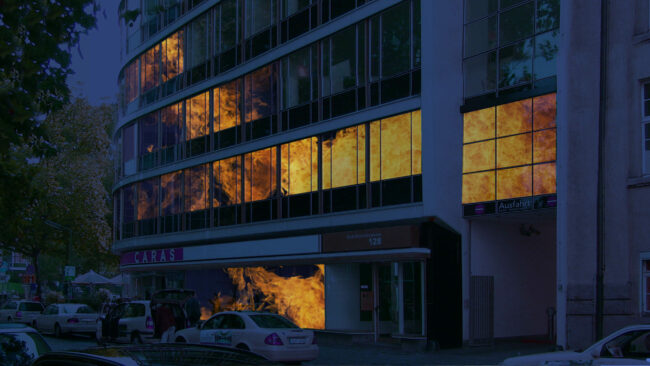
THilden & Diaz – “Fire at Haus Hardenberg”
‘Burning the roots of western culture’ – This is the subtitle of an ongoing art project by the Danish-Argentinean artist duo Hilden & Diaz, creating huge symbolic fires in cities around Europe. Each night in 3 weeks of December, a fire will enlighten Haus Hardenberg in the central West Berlin.
“This time, we strike more randomly and the expression comes more irrational and open than previous”, says Diaz. Previously the artist duo has been burning central cultural institutions as city monuments, churches and museums around Europe. “This we did to question our roots, since these institutions are all of important symbolical, ideological and institutional meaning for our western culture”, says Hilden.
Fire is a symbol that contains contrasting forces; it symbolizes vitalization, but at the same time, it is a symbol of destruction. By burning a random house, the artists want to create an illusion, that there is a possibility that everything can burn down. In that way, the project has a resembling to an act of riots or of terror. “The difference is, that we wish to create an discussion and awareness of these forces. We are working with symbols, not with any destructive force. Our intention is communication”…“People in riots burn totally random things like cars or houses in their way. This kind of random fire is creating much more fear, than hitting a specific target. The latent fear is the force of terror, not the actual target”, say the artists.
In the burning of Haus Hardenberg lies a more general concern about society, than a political statement. The concern revolves around the fires in the world today and the fear they create in society. Through the Fire at Haus Hardenberg, the two artists wish to appeal to a general discussion about and an awareness of cultural questions in our society. This discussion should be available for all people and not only take place inside an art institutional frame.
Throughout history and today Berlin, is a dynamic city in change. Since the project will be returning every year in Haus Hardenberg, the artists hope, that the fire will change its meaning in connection with the ongoing changes in the city and the world. Culture will change and therefore Hilden & Diaz hope, that the perception on Fire at Haus Hardenberg will change, and follow these changes of society.