Forms in Nature Store Works Contact

20130405-154759.jpg

text By Gianni Mercurio

As long as the Coliseum exists, Rome will exist; when the Coliseum falls, Rome will also fall; but when Rome falls the world will fall too. – The Venerable Bede, early 8th century

In the first decades of the twentieth century the historic avant-garde movements realized that it was possible to replace representations of objects with a straightforward presentation of them. But whoever would have believed that, in time, nature itself would then be added to them? It was in the 1960s above all that a series of genial ideas led to the use of the four natural elements: air, earth, fire, and water.

The use artists have made of fire in the development of this new aesthetic is surprising. In classical iconography fire conveyed a moral message: on the one hand, fire was an incomparably destructive element, the herald of disasters and a symbol of divine punishment; on the other hand it symbolically embodied the image of life, the essence of divinity. It was a manifestation of God who, through fire, was made perceptible to the human senses.

The French artist Yves Klein was among the first to realize fire’s potential for new art. Together with the architect Werner Ruhnau, in 1961 he created an installation, Mur de Feu. This was in Krefeld, a German town near Düsseldorf, in the garden of Mies van der Rohe’s Lange House. The installation consisted of five flames arranged in a regular grid. Another work made in the same place was Sculpture de Feu, a column of fire over three metres high. “Space is what is immaterial and limitless” said Klein, and he established walls and floors with an architecture of air and fire. The installation had a double aim: to change the concept of architectural space, by pushing to the limit’s Mies’s axiom that “less is more”, and to give the viewer to a sense of immateriality and purity which, for Klein, was art’s ultimate aim.

[youtube https://www.youtube.com/watch?v=_FzuH8-kdwM&w=560&h=315]

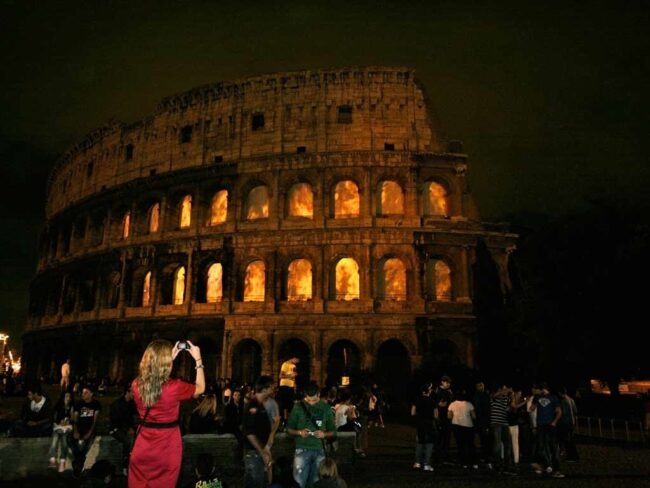
I have presented this very brief overview in order to establish Klein as a touchstone for Coliseum on Fire. This multimedia installation by Thyra Hilden and Pio Diaz will create an amazingly realistic impression of the Coliseum in flames. The artists’ aim is to show just how fragile and fleeting are mankind’s creations, even great buildings that are still considered symbols of eternal culture. In this sense Coliseum on Fire is a humanist project because the image of this great monument in flames cancels the manifest meaning of the Coliseum: a theatre for cruel, deathly combat for the public’s enjoyment.
Thyra Hilden’s and Pio Diaz’s Coliseum has been transformed into a visionary landscape. But once this incendiary installation has been dismantled it will no longer exist due to the vary fact that it was part of a specific architectural context: just as Klein’s installation no longer existed when a flame died down. The difference between Klein, and Hilden and Diaz, lies in the change brought about by the data transmission revolution. This is not so much because of the technological means the two artists use, but because their return to the sphere of representation and narrative demonstrates the need of post-ideological artists to feed on visionary scenes.

The Coliseum is part of the universal collective imagery: it symbolizes a civilization that has had the deepest influence. And the very fact that Coliseum on Fire is constructed from film underlines that its image is a common fantasy. But in this work, more than a building, the Coliseum is a symbol that burns because we are dealing with a representation, a fiction, and not a genuine catastrophe: once the projectors and screens have been dismantled everything goes back to what it was previously.

http://www.flickr.com/photos/91564542@N04/8353704036/

By alluding to the myth of the phoenix, Coliseum on Fire represents the utopia of a return to the past as the path to some future human spiritual and technological evolution. Due to the fire, the empty arches of the Coliseum record the contradictory feelings of humanity in today’s society, feelings about our spiritual ruin and our possibilities of salvation. However, as Klein said, there is a hope: “Fires burn in the heart of the void and in the heart of mankind”.

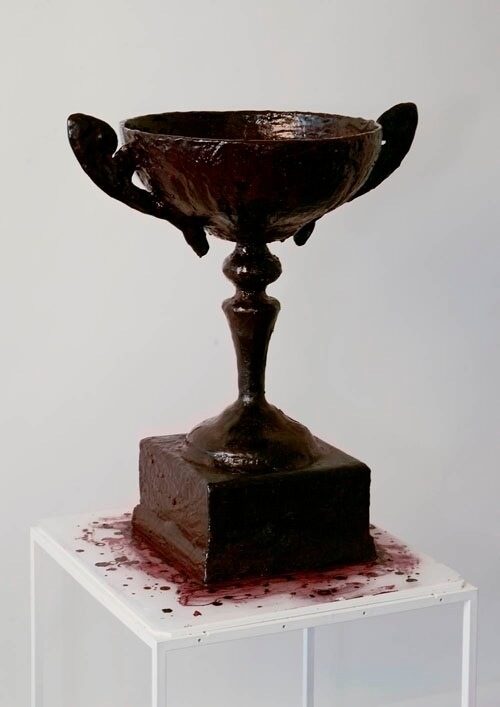
Mixed human blood and polymers.

Pure blood text by Vivian Kathrine Nagy
Due to bloods importance in life, it is symbolically loaded. Therefore the moving of blood between bodies can be seen as more than a surgical innovation because blood is strongly symbolically charged and connected with identity and affiliation. This means that blood, as a vital fluid, gives powerful, cultural, ethic and religious associations. This symbolical dimension of blood is often linked to the terms; blood bonds, blue blood and good or bad blood.

20130406-105109.jpg
One of the main metaphors that are connected to blood is its symbol as a bond between people. In terms of these blood bonds, you can distinguish between two levels: on one hand there is a direct biological bond between people with the same blood type that has an influence on whether they can give and receive blood from one another. On the other hand, you can talk about blood as a more “invisible” bond linking individuals and groups, parents and children, tribes, clans and races together.

Blood today
From being a mythical substance, blood is today more and more seen as a biological organ that transports nutrients around the body. However despite this demystification of blood during the last centuries and focus on its vital function in the body, blood still has a coherent symbolical significance, which makes it one of the most powerful and ubiquitous symbols. Blood signifies life and death, health and disease, power and powerless. The perspective on blood is thus not fixed and it mystical aura remains. One of the strongest influence on how blood is regarded today is, whether it is placed inside our outside the body:

Besides the increasingly status of blood as a commodity in our society today, it is still symbolical loaded. Through dissections down to its organic functions and last details and finally through industrialization, blood has lost its mythical and religious significance during the last centuries. Blood has become a global trading product and to give blood is a human resource in favour of the community.

Blood and Art
Since the 1960s the body has been more and more a subject in art. Generations of action painters and early performance artists confronted the audiences with inflicting injuries upon themselves and several European artists have used animal or human blood in violent actions focusing on the body. Amongst the most famous are the group of Viennese Actionists who were known for their happenings through which the aim was to remove the dividing line between art and life. With references to Dadaistic and surrealistic art, the Viennese Actionists posed questions that challenged the definition of art and deliberately went beyond bounds of what was considered acceptable at that time. Through a focus on the body and self-mutilation the artists draw attention on repressive mechanisms in society. One of the artist for whom blood plays an important role is the Viennese Actionist Hermann Nitsch. He worked with animal blood that he used to pour over his models and over himself and he threw and splashed blood from a sacrificed lamb on models. In these performances lays references to the early religious rituals and also to the Crucifixion of Christ.

The 1970s performances also revolved around body aspects. Michel Journiac made his “Mass for a body” which consisted of a pudding-shaped body made by his own blood, which he offered to the viewers. The sacrifice of human blood in an artistic process echoed the Christ’s sacrifice for the humankind and expressed the artist’s willingness to experience pain as a form of self-expression. Journiac’s work is also interesting, since he makes an object out of his own blood that is connected to him as a subject.

Another example of turning blood into a physical object is the sculpture “Self” made in 1991 by Marc Quinn who created a sculpture by collecting his own blood over five month. Using about five litres, the amount of blood, which is in an average humans body, the artist formed a frozen copy of his own head that is now store in a glass box at -70c. The sculpture is a self-portrait, which contains all the artists data: his facial features, his blood type and his genetic material. In this way the artist creates a memento mori of him self and something for the afterlife to remember him by. In the work he is symbolically present in the shape of his head even if he in reality is absent.

By Julie Damgaard

The Eternal Fire
The flame is an image of fundamental properties for the living and human existence. – Peer F. Bundgård(1).

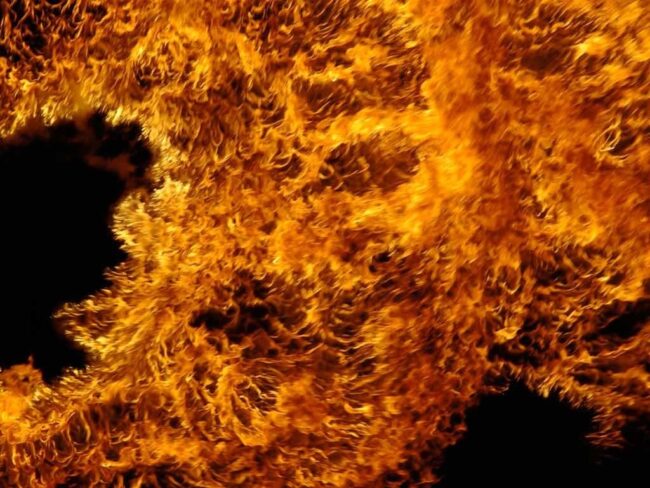
Fire: it has been with us ever since mankind first encountered it. It has been an indispensable, if not always trustworthy, partner in our historical development. With fire we keep a stark relationship with a sometimes faithless character: fully restrained one moment, wholly undisciplined the next. It brings us warmth, but also burns. It keeps danger away, but also reveals our presence. Summons to poetic revery, but also hypnotizes and dazzles us. At times it has left us abandoned, only to return again. Of the four elements– earth, fire, water, and air –fire is the ardent brother. Despite its tumultuous temperament, despite the fact that it is composed not only of benevolent, but also malicious powers, of these four elemental “siblings” it is fire that mankind has always been able to identify with best. Like us, fire is one of the living – a living, upright creature. It is born, needs nourishment and oxygen, it ages and dies.

20130406-103930.jpg

Fire is organic life and has, ever since its original encounter with humans, often shown itself to depend on our “care” in order to survive. In return, it has lent us a bit of its power and served as a vital tool for us, both physically and mentally. Fire has brought us not only protection, edible food, and tools, but also illumination, in the epistemological sense of the word. In observing flames, in seeing our reflection in them, so to speak, humans have achieved a valuable awareness of themselves as a result of a transformation that creates while something else is destroyed at the same time (Bachelard, 1996, p. 15).
Fire has always attracted us and fostered insight and contemplation, made us see as though for the first time. And for the careful observer it has also been the very “illustration” of transcendence: the outgrowth of a shimmering, dynamic, and sublime flame of life able to eradicate or consume an earthly, impure material. A process that is nothing less than the opportunity to grow as a spiritual individual and to create a radically new and different existence. In other words, fire is an illuminator– a source of existential understanding, insight, and identification.

THE HOLY FLAME
The movement of the spirit is like that of the flame– it rises
– Claude de Saint-Martin

That fire is the most “holy” of the four elements was seen early on in mythological narratives and tales of creation from every corner of the world. From African and Indian tribal belief to mystical religion to Greek mythology, it is possible to recognize related archetypal stories of a mystical being that sends humans a cultural boon or tool in the form of fire(2). It was with the rise of the cultural hero and his presentation of the gift of flame that culture came into being and that humans finally assumed their proper character. In Judeo-Christian cultural tradition it is also possible to find examples in the Old Testament of the holy fire’s meaning for the establishment of human order. As stated in Deuteronomy(3), God (Jehovah) manifested as smoke and flames on mount Sinai, and that this descent led to the creation of Israel as a people and a society. In his dissertation on the devouring fire, Hans J. Lundager Jensen, for the same reason, posits the fire on the mountain as the focal point of the Old Testament (Lundager Jensen, 2000, p. 441).

The value of people’s involvement with fire and thereby with holy principles can- and should not be underestimated. As stated above, this plays a major role in human self-understanding and the developmental process. Because for millennia we have strived for– and dreamed of a higher degree of participation in the holy or heavenly aspect of our existence- and the greater knowledge that this participation would bring -it may only be considered natural that we have done everything in our power to maintain fire, both internally and externally.

Fire has burned its way into history, not least because of our constant concern for its survival. The narratives here abound: from the Old Testament’s tale of the devouring sacrificial fire(4), which resided in the Sanctuary and lit the eternal fire of the altar, to the depiction of ancient Rome’s specially selected priesthood of women – the Priestesses of Vesta –who dedicated their lives to looking after the hearth fire in the round Vesta temple; until today, when the eternal fire, in a re-mythologized form, rests on the graves of unknown soldiers as a memory of the victims who were slain in battle, and as a mark of eternal life not only in the hereafter, but also in the memory of subsequent generations(5).

Lastly, we also guard the Olympic Torch, which is lit before every Olympic Games using the rays of the sun in a parabolic mirror and then carried via a torch relay from Greece to the place where the games are to be held. As a mark of the fiery soul and competitive spirit of Olympic athletes, it shines over the place where the games are held, and at the same time evokes the flame that in ancient times burned in honor of Zeus during the major religious festivals of the Greeks.

THE PSYCHOLOGY OF FIRE AND THE PHYSICS OF THE FLAME OF LIFE(6)
The world is a seed for a better world, just as humankind is a seed for a better humanity, as heavy yellow flames are a seed for a white and lighter flame.
– Gaston Bachelard

Just as people have forever guarded wild fire and cared for its continued existence, so have we also guarded over the flame of the mind and instinctively felt its periodic surging and quelling. We have long known the necessity of not only gathering alongside the dying bonfire to continue having light and warmth throughout the darkness of the night, but also of lighting our inner fires, when the spark of life is low. Only through a purifying fire is it possible to reclaim power, to leave the depths of existence and supply the spirit with the energy that it needs to again rise like a flame in all its upright glory. Only after the spirit has shown itself that the burning down of melancholy’s “black matter” – the transformation of its “physical” qualities into ethereal ones – is there absolute vitality of life; and it may also bring the benefit of lifting the soul to even greater heights, and one matures as a spiritual being. By burning one’s bridges and starting anew, by burning one’s inner demons and “giving oneself over to the fate of the flames” (Bachelard, 1996, p. 77), one can claim to have reached a new degree of fullness of life and wisdom.

By observing and decoding the pulsating of the outer flame have learned many things, and much about the inner flame: about the movements of the mind and soul, and how the inner being – our secret power -can be strengthened and disciplined. Fire has shown itself not only to have the power to improve our daily lives, but also our mental lives. As the most important instrument for any extensive cycle of transformation, it has illuminated the world of mankind.

THE FIRE OF ALCHEMISTS: DEGREES OF FIRE
’Animus ex inflammata anima constat’ – ’The soul is made of burning air’’
– Cicero

We find some of the best examples of fire as both an inner and outer power in the old alchemical tracts from the middle ages. The alchemists were the scientists of ancient times, and their purpose was not only to refine metals such as iron and lead, but also to refine organic materials. Based on the theory that everything contains the four elements in varying proportions, it was the conviction of the alchemists that by changing a given material’s proportional content of, for example, air or water, it was possible to transform it into a more valuable product, such as gold. The alchemist practiced this transformation primarily by exposing the materials to intense heat.

What few of them realized was that this ’business-like’ work would gradually entail a refinement of soul of the learned. The intense observation of the flames in Athanor– the alchemist’s kiln –brought about a dreamlike or philosophical introspection in the alchemist, whereby he came to see the glow of the kiln as reflecting his own inner being. He came to see that his mind must be able to undergo the same transformation that his material went through when exposed to the heat of the fire. In a type of parallel process, the alchemist purified both his physical materials and his soul, creating the conditions for something new and improved to emerge, like a phoenix rising from the ashes.

Through the four stages of dissolution and reconstitution that characterized opus alchymicum, the alchemist came closer to his final goal: divine consciousness. A goal that was attributed to fire as an element(7). The process was slow, and could in some cases stretch over most of a lifetime. Every time the alchemist managed to advance a step further along the path of transformation, he was again forced to let his material melt or rot away– to let it dissolve into so-called prima materia. From the black, earthly stage (nigredo) he would first go through the white, aqueous and yellow, atmospheric stages (albedo and citrinitas), before finally reaching the red-hot and final stage (rubedo): the transformative stage, where he was at last able to make unsound (impure) metal sound, and thereby attain complete sublimation of the soul. A level that meant spiritual transcendence and ’resurrection,’ and even immortality.

At each of the four stages of transformation, fire’s strength as a portent transformative power doubled. Only the development of the fire – from slow and mild to moderate and temperate to powerful and strong, and finally to burning and violent as a purgatory or ecpyrosis(8) – could make it possible for the alchemist at the last moment to “shine with the tireless light of the sun itself” (Fabricius, p. 15).

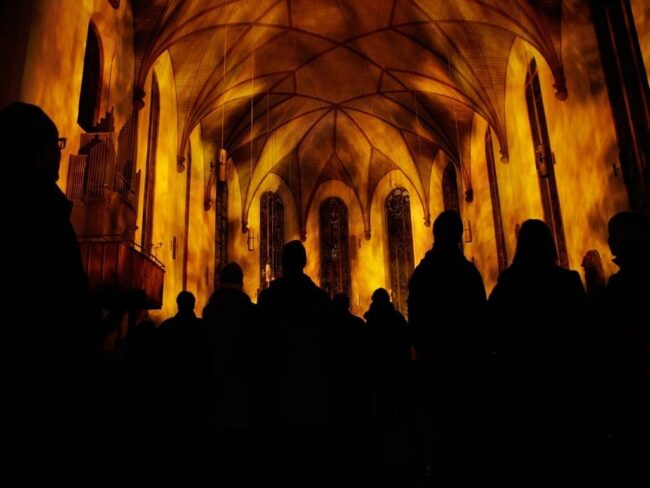
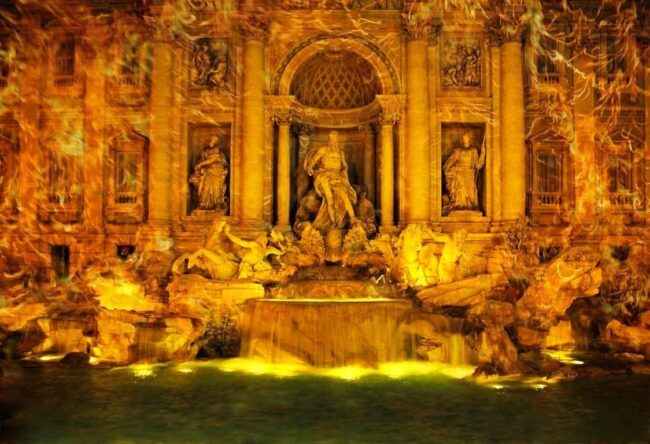
Whereas alchemy, because of its philosophical, esoteric, inward–looking and creative qualities –upgraded fire, modern chemistry has downgraded it to an atomic reaction. Nonetheless, fire can still inspire and move us, and as a result of its power of influence and suggestion, it often appears in art. The project City on Fire is a good example of this. Through large-scale video installations, the artist duo Thyra Hilden and Pio Diaz “burn” down a number of western culture’s major monuments and institutions. Working from the basis of a contemporary type of alchemy, the couple unleashes the purifying soul of fire and lets quintessential cultural icons be consumed by the flames in order to revitalize culture and art.

Holy flame, strong in your glare
Everyone fighting for the wreath of the muses!
Knowledge, your stem may flowering stand,
Eternal, but the changes of time go on.
– J. L. Heiberg

1. From the foreword to Lysets Flamme by Gaston Bachelard, Danish translation by Peer F. Bundgård
2. Agni is a central figure in the mystical religions that the Aryan peoples 3.500 years ago brought from Central Asia into northern India. Lik eother vedic gods he represents a natural phenomenon – namely fire. Agni´s movements in heaven, the air, and on earth make him a bridge between gods and humans, while he also plays a significant role as a cosmic principle.
3. Greek for the 5th book of Moses
4. The sacrificial fire is not only the medium of transformation, but also an image of the receiver of the transformed victim, namely Jehova.
5. Fire also has a strong connection with burial rituals in the form of cremation. In religious terms, the burning of a corpse is mainly tied to Buddhism and Hinduism, but as a ritual funeral practice it is also known in the North and large parts of Europe. Cremation was especially widespread during the millennium before Christ (cf. Den Store Danske Encyklopædi).
6. Adapted from Gaston Bachelard (Bachelard, 1996, p. 36)
7. Gold was valued in alchemy because it was thought to contain an elementary fire (Bachelard, 1993, p. 95)
8. In ancient stoic cosmology, ecpyrosis symbolized the burning of the world, where everything is pure fire (energy). According to this way of thinking, the ultimate ecpyrosis is also the beginning of a new world identical to the old. Pure fire, which is also God, forms new material of itself, which God (as a spirit) then directs towards a new ecpyrosis (cf. Den Store Danske Encyklopædi).

SOURCES
Bachelard, Gaston: Lysets Flamme, Danish translation by Peer F. Bundgård, FilosofiBiblioteket, Hans Reitzels Forlag, Copenhagen, 1996

Bachelard, Gaston: Eldens Psykoanalys, translated by Marianne Lindström, Skarabé, Lund, 1993

Blumenthal, P.J.: ”ILDEN skabte det moderne menneske”, i Videnskab for alle, no. 1, 1986, pp. 40-46

Fabricius, Johannes: Alchemy – The Medieval Alchemists and their Royal Art, Rosenkilde og Bagger, Copenhagen, 1976

Geertz, Armin W.: ”Disputats om ’den fortærende ild’. Fra Brasilien til Hellas – bemærkninger til Hans J. Lundager Jensens disputats”, i Religionsvidenskabeligt Tidsskrift, no. 39, 2001, pp. 61-70

Jensen, Hans J. Lundager: Den Fortærende Ild – Strukturelle analyser af narrative og rituelle tekster i Det Gamle Testamente, Aarhus Universitetsforlag, Århus, 2000

Jensen, Hans J. Lundager: ”Ilden mellem himmel og jord. Skitse til en gammeltestamentlig kosmo-ontologi”, in Dansk Teologisk Tidsskrift, 66. årg., no. 4, 2003, pp. 231-259

Nielsen, Kirsten: ”Den fortærende ild. Religionsvidenskabelig disputats med teologiske perspektiver”, in Dansk Teologisk Tidsskrift, 64. årg., no. 3, 2001, pp. 176-189

Nielsen, Kirsten: ”’Gud Herren kaldte på ilden til dom’ – Dommedagsmotivet og dets forskydninger”, in Dansk Teologisk Tidsskrift, årg. 58, no. 1, 1995, pp. 3-15

Pyne, Stephen J.: Fire – A Brief History, foreword by William Cronon, The British Museum Press, London, 2001

20130406-103850.jpg
20130406-104001.jpg

20130406-104052.jpg

By Lisbeth Bonde

Old Houses Ablaze
Thyra Hilden & Pio Diaz destabilize European cultural history by setting monuments on fire.

The Danish-Argentinean artist couple Thyra Hilden & Pio Diaz set the monuments of western cultural history on fire in their joint and ongoing video project “City on Fire.” With their seductive and spectacular artistic gesture, they reveal the fragile and transitory nature of these man-made constructions, and thereby destabilize prevailing order. The old monuments serve as weighty expressions for western culture and identity, and have to a certain extent functioned as templates for later constructions in cultural history. As such they constitute a physical foundation for western self-understanding, which the two artists unpack and recast in their edgy work. The artist couple chose these historical monuments and institutions with great care, only to then consign them to the flames in their large-scale and dramatically staged work. These ephemeral works tend to release equal parts of anger and joy from the audience; the illusion is so convincing, and our instinctive reaction to fire so deeply engrained, that we immediately place ourselves on guard when we see such cherished buildings drowning in flame.

Fire is one of the four elements. It is made of incandescent gas and other combustible materials, such as carbon. It is ignited by a spark or through another fire (such as explosions, fire in the oven or in the fireplace), it is summoned forth with a lighter, a match, or a cigarette, – or it can be created when the rays of the sun are caught in a mirror. It arises when a combustible material is supplied with oxygen and exposure to sufficient heat. In nature, forests burn as a part of natural cycles, so that new trunks can spout and new life can emerge. Carbonized wood can be used as a fuel, and the charcoal can be used as a medium to draw or as makeup. All these associations, along with our instinctive fear of fire, are at play both consciously and unconsciously in the story that Hilden & Diaz put forth in their project “City on Fire.” The monuments are instilled with new life – in a sea of fire, they rise again like a phoenix in all their splendor and monumental glory. They appear as flamboyant, illuminated objects of beauty in the fire’s glowing waves. White marble and shimmering, fallen walls turn into gold in the darkness of night. The experience is so realistic, so hyper-real, that only one sensory impression is still needed to complete the experience: heat. The video flames have no all-consuming appetite like real flames, and they won’t make sweat beads on the foreheads of viewer, who might be standing comfortably under rain-soaked umbrellas until the video cannons are silenced and the monumental buildings come forth again with their enormous mass wholly intact in the blackness of night.

20130406-102922.jpg

Fire holds two contrary properties: it can cause severe damage and destroy essential natural and cultural values when encountered in the form of an all-consuming fire that arises on its own. It is this kind of fire that humans and animals have feared for as long as they have walked the planet. That’s the fire that’s at play here – searing and destructive. But its tamer version, when held in check by fireproof materials such as stone or metal, has been our invaluable friend, ever since Homo Erectus emerged from apes some 700-800,000 years ago and ground two sticks together. Then we’re speaking about cold fire- the word “bonfire” being a direct translation of “good fire…” this is the fire that, when kept under control (such as in a fire pit), people have gathered around for hundreds of thousands of years. Throughout all of our cultural history, controlled fire has acted as a fuel for cultural and technological development. It provides us with light and heat and has been an indispensable tool in our households as part of our cooking, and has also been able to destroy pathogens, aiding our well-being still further. Several millennia ago, fire played the all-important role in our transformation from hunter-gatherer society to an agricultural society when we first burned down the forests in order to sow our fields. Fire has also made it possible for people to move to colder parts of the globe.

But human hands have also exploited controlled fire for destructive purposes, as a weapon of war. In ancient times and the Middle Ages, burning arrows were shot at the towns and homes of enemies, and from ancient Greece we know the story of the Trojan horse filled with Greek soldiers who then shot burning arrows into Troy, which was then reduced to ashes. If we take an enormous step forward to our own time, we observe the Germans burning the earth during their retreat from northern Finland during the Second World War. They set fire to large areas of land, towns, and factories in order to starve and humiliate the victor. From the 20th century onwards we have crowned our enemies with bombs that then explode and set buildings ablaze – with the atomic bomb standing as the most severe form of weaponised fire, which contaminates everything for kilometers around. During the Vietnam War, the Americans used napalm bombs against North Vietnam. These bombs burned everything. And today, USA holds neutron smart bombs that burn everything alive. A bit more primitive is the Molotov cocktail, used in street riots and guerrilla warfare, thrown at the opponent to set smaller areas on fire. It’s a bottle filled with a combustible fluid– such as alcohol or gasoline. The bottleneck serves as a wick, and then the bottle strikes its target; it explodes and sets fire to a targeted, localized area. In Denmark’s 1993 Nørrebro riots, demonstrators overturned containers and cars, setting them on fire in the streets around the black square. Fire conveys chaos and destruction and threatens sudden death.

20130406-102930.jpg

Fire is also a part of most religious rites in the form of sacrifices, i.e., burning of crops or slaughtered animals for the gods. When the smoke reaches heaven – where most religions imagine that their god or gods reside –the sacrificial smoke becomes theirs. In the Old Testament we know the story of Moses, who saw God in the form of a burning thorn bush, smouldering without flames. God told a frightened Moses that He had chosen him to lead the Israelites out of Egypt to the Promised Land, Israel, which flowed with milk and honey. And Greek mythology tells us of Prometheus as a Titan who stole fire from Olympia and gave it to humankind. Prometheus has thus become a symbol of humankind’s struggle with the gods, and the term “promethean” refers to a lively person, who rebels against a given order. The North American Indians also made use of fire – but in a very special way, as they used it to communicate with subtle smoke signals that could be spotted over long distances on the American plains, and in South America, in the Inca culture; people revered the Sun God, who represented a life-giving fire.

As stated above, fire has its own cultural history. At the same time, it operates metaphorically on many levels. It is said that an old home can catch on fire when the desires of its elderly inhabitants suddenly come ablaze. Desire as a whole often appears metaphorically as fire – we say “you light my fire;” those who demonstrate a “glowing” enthusiasm have a “fire in the soul.” There is no smoke without fire, says an old proverb, suggesting that everything has a cause. “He had a spark,” we say – the spark being fire –when thoughts suddenly spring to mind. In his story “The Temperaments,” H.C. Andersen describes the four elements as equivalent of the four temperaments. The Choleric is as such the “Fire king,” a self-igniting lantern man, who is called forth with a lighter. “Chemistry!” he shouts, knowing what he and the entire world is made of, knowing what parts went together and what parts did not. “I know chemistry! And I know myself, where I come from, where I am going, all of it!” This short-tempered fellow had a violent temperament that burst out into the open, and wherever he went, he laid waste with his tongue of fire. Fire has an innate fury that builds and grows faster when given the right fuel. Fire is not satisfied until everything is turned to ashes and the world is turned back to a barren and carbonized state.

Fire will always be burning one place or another in the world, and so long as it exists, we can reap its benefit. Wherever human activity is to flourish, we tear down in order to build up. Fire is an irrational, ambiguous, and immaterial phenomenon rich in contrasts that can both reap destruction and wrap itself warmly and lovingly around humankind. It can make our cultural roots vanish in the course of a few minutes, and all of our entire modern life incessantly burns away for new technology and new forms of life to be able to constantly grow forth. This fear of fire’s all-consuming power helps intensify the tension experienced in “City on Fire.” Here we see modern technology – namely digital video media –confronted with classic works of architecture – and in this connection there arises a meeting full of contract between orders new and old. These burning scenes by Thyra Hilden and Pio Diaz call the world’s continued existence into question. Through their international-based and monumental approach and enormous statement, the couple’s work is reminiscent of Christo and Jeanne-Claude’s massive installation projects.

Lisbeth Bonde is an art columnist for the Danish paper Weekendavisen. She is the author of several books, including ’Kunstnere på tale’ (2001), ’Atelier – kunstnerens værksted’ (2003), SOLO – en monografi om Peter Martensen (2006) and (with Mette Sandbye) ’Manual til dansk samtidskunst’ (2006).

20130406-102945.jpg
20130410-105735.jpg20130410-105749.jpg20130410-105803.jpg20130410-105816.jpg20130410-105828.jpg20130410-105843.jpg20130410-105910.jpg20130410-105920.jpg20130410-163946.jpg20130410-163959.jpg

20130410-164009.jpg

20130410-164047.jpg

By Line Rosenvinge

We take pride in our cultural institutions. They reassure us of the refinement of our civilization. Every little city of a certain size feels the need for a cultural institution. Along with a town hall and a church, a museum make things seem complete.

ls the essence of culture linked to other constructs than the buildings that house cultural products? Would there be no culture, if these cultural institutions were destroyed?

In Aarhus the destruction happens. The art museum is set on fire. More than 50,000 inhabitants of the city can watch from the windows of their homes as flames lick away the building, turning the popular ARoS Aarhus Art Museum, beloved by the citizens, into a glowing cube of silent, smokeless fire.

Art itself does it. Using huge projectors, to throw images of live burning flames on the museum, artists Pio Diaz and Thyra Hilden produce a museum wrapped in flames.

As visual artists, their gesture is neither aggressive nor destructive, they do not demolish what cannot be replaced. Their art is a symbolic inferno, their fire an illusion to seduce and make us wonder what the loss of such a cultural institution would be like. They are not simply playing with fire, they are also playing with your mind.

The burning begins on the first of the day a Danish newspaper published the Cartoons of the Prophet, which caused a series of boycotts, and saw demonstrations across the world. Muslims burned the national Danish flag as a symbol of their anger. Clever thinking! lf you attack my symbols, I will attack yours. Let us stick to a war on icons.

The sad fact is we do not. Denmark is still at war in foreign fields. What was long supposed to have been merely a peacekeeping force has turned into real combat for Danish soldiers in lraq. Whatever the motives, whoever is responsible – what happens to the cultures that are attacked in the name of culture and democracy? | hurt you to make things better, because I know what is best for you.

Fights and fires some times get out of control. Within moments values – in every sense of the word – can be destroyed forever. They say people with culture never go wrong, and it is true that the strong beauty of the past makes us proud and aware that we are at the end of a long evolution. We need to know our past to understand the present and learn from failures of the history of mankind. But some times the past feels like a heavy burden to carry. Culture and knowledge of the past can limit expressiveness in the present! Culture and cultural production bear an element of destruction. The pupil has to exceed the mentor and personalize tradition.

Some one hundred years ago a group of ltalian intellectuals formulated the idea of destroying the proud monuments of the past. They glorified industrialization and mechanization. They loved cars and planes for their speed and vitality. They believed man had proved himself to be in control of nature, and they saw destruction as artistic expression: tradition is nothing, the future is all. These artists had no patience. They were inspired by modern warfare and supposedly laid the foundation for the Fascism later accepted by the general ltalian public. The group goes under the name of the Futurists and counts Milanese painters like Boccioni, Carrá, Russolo, Balla and Severini among its numbers. In the Manifesto of Futurism(1) , the poet Filippo Tommaso Marinetti declared:

“We will fight with all our might the fanatical, senseless and snobbish religion of the past, a religion encouraged by the vicious existence of museums. We rebel against that spineless worshipping of old canvases, old statues and old bric-a-brac, against everything, which is filthy and worm-ridden and corroded by time. We consider the habitual contempt for everything which is young, new and burning with life to be unjust and even criminal.”

The Futurists had strong faith, justified cultural destruction and wanted all old things gone. Umberto Boccioni wrote the Manifesto of Futurist Painters in 1910 with these famous words:

“We will glorify war-the world’s only hygiene-militarism, patriotism, the destructive gesture of freedom-bringers, beautiful ideas worth dying for, and scorn for woman. We will destroy the museums, libraries, academies of every kind, will fight moralism, feminism, every opportunistic or utilitarian cowardice.”(2)

Boccioni would probably hail the fact that American soldiers in lraq today are provided with the song Fire Water Burn by Bloodhound Gang. lt goes: “The roof the roof the roof is on fire. We don’t need no water let the motherfucker burn. Burn motherfucker burn”(3). This is the sound track that excites combat groups to destruction. lt is easy to imagine how this song makes the adrenalin pump and produce a real life simulation of a computer game… Target in sight… Target locked … Target destroyed …

Myths of Creation do speak of destruction. You will have to tear down to build up, but destruction comes in different forms, it can be either nurture or attack. lt is not easy to decide when cutting back the rose, to remove the bad stops being pruning and becomes brutality. And when it comes to culture, who is to decide what are the weeds? Whatever the religion, it is still a question whether it is acceptable for Taliban warriors to destroy statues of Buddha in Afghanistan. Similar events have taken place around the world through all times. lt seems cultures act aggressively to develop and expand. ln the wake of the Cultural Revolution in China, great things disappeared, but later it was the statues of Mao that were taken down by the people. Paradigm shifts are often brutal to architectural monuments and other cultural icons. Just think of the artistic and literary treasures that were burned as Entartete Kunst by Nazis during WW2, let alone by Christians and other religious movements who feared the power of literature and culture and wanted to remove cultural products that did not fit into their ideological scheme. The images – the burning illusion – by Thyra Hilden and Pio Diaz bring to mind all these disruptive and aggressive cultural turns.

Destruction, in the form of a clean break with the past, can be collective as well as personal. The large scale collective destruction of the past, suggested by the Futurists, proves an awkward link to contemporary Feng Shui, which is a vulgarization from an Eastern philosophy about simple living, now promoted in lifestyle magazines telling us how to tidy up and take control over our lives. According to Feng Shui, we will find greater happiness and less friction if we throw away the things we do not need and tidy our homes and workspaces.

There is something very tempting about this idea. We have all at some point tried to start from afresh, or have deeply wished for it to happen, while actually repeating the same limited patterns. Minimalist Art also speaks of the Tabula Rasa, the idea of escaping the past and having a virgin white canvas for thinking and acting, the quintessence being Robert Rauschenberg’s Erased Dekooning from 1953(4). One artist making a statement by carefully erasing the art of another famous artist.

Could you write off material life and destroy your most cherished belongings – or all your belongings? Artist Michael Landy did(5). In, Oxford Street, London’s busiest shopping street, he organized a thorough destruction of all his belonging. Small things like clothes, records, books, and porcelain were easy, but there was also a car and all the furniture, plus art work by himself and those given to him by fellow artists. Nothing was spared. Artworks by Damien Hirst, Tracey Emin and the like were all crushed into tiny chips. The art project looked like a factory with workers spending several days intensively crushing things in a special rig. The project wished to question consumerism.

City on Fire, and the burning of ARoS Aarhus Art Museum, by Thyra Hilden and Pio Diaz
celebrate all these issues about the power of cultural heritage and the beauty of destruction. Their statement is a subtle intervention but proves to have a powerful impact. Would it make life easier if you had no past, no belongings? Would we have no culture if all cultural institutions were gone? Close you eyes and watch the flames. Watch it burn down to the ground. Now, how does that make you feel …

Line Rosenvinge, Master of Arts, Tender Task Ltd

1. First released in Milan where the movement was based and later published on the front of the French paper Le Figaro, February 20th, 1 909.
2. Article 9 and 10 in Manifesto of Futurism by F. T. Marinetti, 1909. In ltalian: ‘Noi vogliamo glorificare la guerra – sola igene del mondo – il militarismo, il patriottismo, il gesto distruttore. Noi vogliamo distruggere i musei, le biblioteche, le accademie d’ogni specie e combattere contro il moralismo, il femminismo e contro ogni viltir opportunistica o utilitaria”.
3. In the film Fahrenheit 9/1 1 it came out that American soldiers in lraq are supplied with music samples of heavy rock and the like to listen to.
4. Robert Rauschenberg’s Erased Dekooning is part of the MoMA collection, NYC
5. The project Breakdown by Michael Landy came about in the spring of 2001 with support from Artangel.

20130406-102320.jpg